
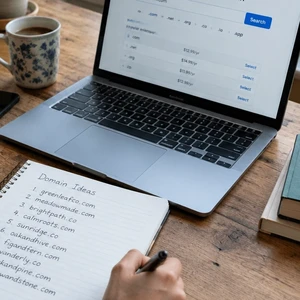
 Choosing a domain name is easier when you think beyond what is available today. Your domain may appear on business cards, invoices, social profiles, and email addresses. It should be easy for people to remember and flexible enough to grow with your plans.
Before registering a name, take time to check how it sounds, what it might be confused with, and whether someone else already has a claim to it. A little research now can save you from a frustrating rebrand later.
Start with a name people can remember
A good domain name should be easy to say, hear, spell, and type. Imagine telling someone your web address over the phone. Would they know how to spell it without asking you to repeat it?
Short names are often easier to recall, but clarity matters more than squeezing every character out. A name that is short but confusing may send customers to the wrong place.
Try saying your favorite options aloud. Then ask someone else to write each one down after hearing it. If they regularly misspell the name, simplify it before registering.
Hyphens and numbers can make a domain harder to share. People may wonder whether a number is written as a digit or spelled out. Hyphens are easy to forget, especially when someone hears your address rather than seeing it.
Double letters can also cause mistakes. For example, people may not know whether a name contains one letter or two. These patterns are not always dealbreakers, but test them with real people before committing.
A quick test: say the name once, then ask someone to type it. If you need a long explanation, keep brainstorming.
Check for lookalikes and awkward meanings
A domain does not appear with spaces between its words. Read your shortlist in lowercase and look for combinations that could be misread. A harmless phrase with spaces can look less clear when everything runs together.
Also search for close variations. Check common misspellings, singular and plural forms, and names that sound similar when spoken. A neighboring business with a similar name could confuse customers, even if its website looks unrelated.
Search the exact name in a search engine and on social platforms. Look for businesses, products, or public discussions using the same wording. Check relevant maps, directories, and marketplaces too.
Think about what happens when someone mistypes your address. If a close variation leads to a competitor or an unrelated site, consider whether you can register that variation too. You do not need to buy every possible spelling. Focus on likely mistakes that could cause real confusion.
Check trademarks and existing businesses
Domain availability does not mean a name is legally available for your business. Registering a web address does not automatically give you trademark rights.
Search for the exact name and similar names used by businesses in related fields. In the United States, you can start with the United States Patent and Trademark Office trademark search. Search your state’s business-name records as well, and check for businesses using the name online.
Pay attention to names that look or sound alike, not just exact matches. A similar name may still confuse customers, particularly if both businesses offer related products or services.
If you plan to operate in other countries, check the relevant trademark resources there. The World Intellectual Property Organization also provides international trademark search information.
These searches are useful first steps, not a legal clearance opinion. If your preferred name appears close to an existing brand, ask a qualified trademark professional before investing in it. It is much easier to adjust a shortlist than to rebuild a brand.
See whether the matching social handles are available
Look for your preferred name on the social platforms your customers use. A matching handle can make your business easier to find and remember.
You do not need an account on every platform. But if your business relies on a particular network, check its handle before registering the domain. A name may look consistent on your website and social profiles, or it may require awkward additions.
If your exact handle is taken, consider a clear alternative. You might add a simple location or business descriptor, if that still sounds natural. Avoid a string of extra punctuation or numbers that makes the name harder to remember.
Check the name in more than one place. A platform’s search can reveal active accounts, while a direct profile search may show whether the exact handle is already in use. Availability can change, so reserve the accounts you genuinely plan to use.
Choose the extension that fits
The extension is the ending after the dot, such as .com or .org. A .com address is familiar to many people and can be a practical choice for businesses serving a broad audience.
Other endings may fit too. A .org extension is commonly associated with organizations, while .net is another established option. Newer extensions can offer a memorable match, but some visitors may still instinctively type .com.
Country-code extensions can make sense when your business serves a particular country. Before choosing one, check any local registration rules and whether the extension fits your plans.
Compare the regular renewal price, not just the introductory offer. Also consider how easy the extension is to say, whether customers will trust it, and whether it could be mistaken for another address.
Choose the extension you are comfortable sharing aloud and printing on your materials. A clever ending is not helpful if customers keep typing the wrong one.
Check a domain’s history before buying it
A domain that has been registered before may carry a past you cannot see from its current page. It could have been used for a business, a personal site, spam, or something else entirely.
Before buying a previously used domain, enter it into the Internet Archive’s Wayback Machine. Review available snapshots from different periods. Look for what the site represented and whether its content or purpose changed substantially.
Search the name in a search engine too. Try versions with and without “www,” and look for old references, complaints, or unrelated business listings. If you are buying from another owner, ask about the domain’s past use and confirm that the seller can transfer it to you.
The Wayback Machine is helpful, but incomplete. A missing page does not prove that the domain was never used. Treat what you find as useful clues, not a complete history.
Protect your domain after registration
Choosing a name is only the beginning. Make sure the domain is registered to you or your business, with contact details you can access. Keep your registrar account secure and use a monitored email address for renewal notices.
Turn on automatic renewal if it suits your situation, and keep your payment details current. Add a reminder to check the renewal date as well. An expired domain can interrupt your website and email, and recovering it may be difficult. Read more in our guide to what happens when your domain expires.
Enable a domain lock when your registrar offers one. This helps prevent unauthorized transfers, but it does not replace a strong password or account security. See why your domain lock matters.
Consider registration-data privacy if your registrar provides it. Privacy services can help limit the personal details displayed in public registration records, although they do not make you anonymous. Learn more in our guide to WHOIS and what the internet can see about your domain.
Make a confident choice
Before you register, say your shortlist aloud, check likely spelling mistakes, search for similar businesses, and review trademark records. Compare social handles and extensions, and look into a domain’s history if it has had a previous owner.
A strong domain does not need to be clever. It needs to be clear, memorable, and right for the people you want to reach. Take the time to check your choice now, and you can move forward with more confidence.









 European Union General Data Protection Regulation Compliant